


The Three Temples
Dr. Andy Woods Sugar Land Bible Church
One way to get a perspective on what God has done, is doing, and will do is to become familiar with the various temples of Scripture. To this end, my next three articles will explore what the Bible teaches on this important subject. To begin with, it is helpful to understand the four Jewish temples. Two of these temples existed in past Jewish history. Two of these temples will exist in Israel's future.

TEMPLE #1
The first temple is called Solomon's temple because it was built by King Solomon (1 Kings 5-8) around 950 B.C. Recall that God did not let King David build this first temple since he was a man of war (1 Chron 28:3). Although David embarked on numerous projects in preparation for the nation's first temple (2 Sam 24:18-25; 1 Chron 21:18-26), the honor of actually building the temple went to his son Solomon, who was Israel's third king. When this temple was built, it was indwelt by God's shekinah glory (2 Chron 5:14). This temple was plundered (2 Chronicles 36:7) and eventually destroyed by the Babylonians when the Jews were taken into captivity in 586 B.C. (2 Kgs 25:9).
TEMPLE #2
The second temple of Scripture is referred to as Zerubabbel's temple. It was rebuilt under the leadership of Zerubbabel (515 B.C.) when the Jews returned from the 70 years of Babylonian captivity (Ezra 6:13-15). The ministries of the post-exilic prophets Haggai and Zechariah were largely dedicated toward motivating the returnees to rebuild this second temple (Ezra 5:1-2). When the older Jews who remembered Solomon's temple saw Zerubbabel's temple, they wept because it paled in comparison to the physical magnificence of Solomon's temple (Ezra 3:8-13; Hag 2:3). This second temple was desecrated by the Selucid Antiochus Epiphanes during the intertestamental period (169‒167 B.C.). The desecration and eventual liberation of the temple from Selucid rule was predicted 400 years in advance by the 6th century exilic prophet Daniel (Dan 8:9-14; 11:31-32). This intertestamental liberation also forms the background for the holiday in Judaism known as the Feast of Lights or Hanukkah, which means dedication (John 10:22).
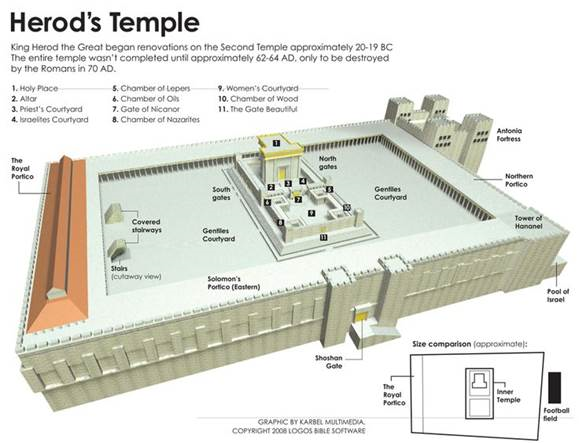
This second temple was renovated years later by King Herod (John 2:20). This is the temple we read so much about in the New Testament. For example, Jesus entered the temple as a youth and confounded the religious leaders with His wisdom (Luke 2:41-50). As an adult, He drove the money changers out of the temple (John 2:12-22). Satan took Him to the pinnacle of this temple to be tempted (Matt 4:5). The disciples called Christ's attention to the beauty of the temple (Matthew 24:1). The early church met in the courts of the temple (Acts 2:46). All of these passages are references to this second Jewish temple which was built under the leadership of Zerubbabel and renovated by Herod. This temple was ultimately destroyed by the Romans when they invaded Jerusalem in A.D. 70. Forty years before this invasion, Jesus predicted that this second temple would be destroyed (Matthew 24:2; Luke 19:41-43).

TEMPLE #3
The third temple is referred to as the tribulation temple. It will exist in the future and will be the temple that the Antichrist will desecrate midway through the tribulation period. In so doing, the future Antichrist will imitate Antiochus Epiphanes who also desecrated the temple in intertestamental times (Dan 9:27; 11:31). Just as Antiochus of old set up a pagan image in the temple, it appears that the future Antichrist will do much the same thing (Rev 13:15). Thus, prophetic Scripture demands that this temple must be rebuilt so that the Antichrist can desecrate it. There are four biblical references to this coming temple. One of these references comes from the Old Testament and three of them come from the New Testament. Daniel made reference to this future temple. Daniel 9:27 says,
"He will confirm a covenant with many for one 'seven' but in the middle of that 'seven' he will put an end to sacrifice and offering. And one who causes desolation will place abominations on a wing of the temple until the end that is decreed is poured out on him."
Jesus also made a reference to the tribulation temple. In Matthew 24:15, He said,
"So when you see standing in the holy place 'the abomination that causes desolation,' spoken of through the prophet Daniel..."
This verse is a quote from Daniel 9:27 and deals with Antichrist's future activity in the tribulation period. The term "holy place" refers to the inner sanctuary of the tribulation temple. Paul also referred to the third temple. In 2 Thessalonians 2:4, he writes,
"He (Antichrist) opposes and exalts himself over everything that is called God or is worshipped, and even sets himself up in God's temple, proclaiming himself to be God."
John also mentioned the third temple. Revelation 11:1-2 says,
"I was given a reed like a measuring rod and was told, 'Go and measure the temple of Godand the altar, and count the worshipers there. But exclude the outer court; do not measure it, because it has been given to the Gentiles. They will trample on the holy city for 42 months" (italics added in above citations).
http://www.bibleprophecyblog.com/2011/08/temples-of-bible-part-1.html
The 3rd Temple is also the Millennial Temple written of in the book of Ezekiel 40-43. Ezekiel describes the Millennial Temple in great detail. Ezekiel Chapters 43-48 tells us about the future relationship between Jesus, the nation Israel, and the Temple. The order of worship and sacrifices in the Temple are also described in detail. Jesus’ Kingdom “…on Earth as it is in Heaven” (Matt. 6:10), will be ruled by Him from His throne in the Temple in Jerusalem. Five scriptures prophecy the coming Millennial Temple:
Isaiah 56:7
Isaiah 66:20-23
Jeremiah 33:18
Zechariah 14:16-21
Malachi 3:3-4
Israel will be exalted from among the nations of the world during the millennial period of time. They will finally inherit all of the lands promised to them by God. (Ezekiel 47-13; 48:8) (Gen. 15:18)
God fulfills all of His promises. Israel is no exception. Through the history and prophecy of the Temples, we can see that God has not forsaken His chosen people, even in their rebellion. The same is true for His saints who have accepted His son Jesus. God is eternally and perfectly faithful to the Church, to whom He has given eternal promises, as well as Israel, to whom God has given promises. We as Christians only need to have enough faith to believe.

Comments